
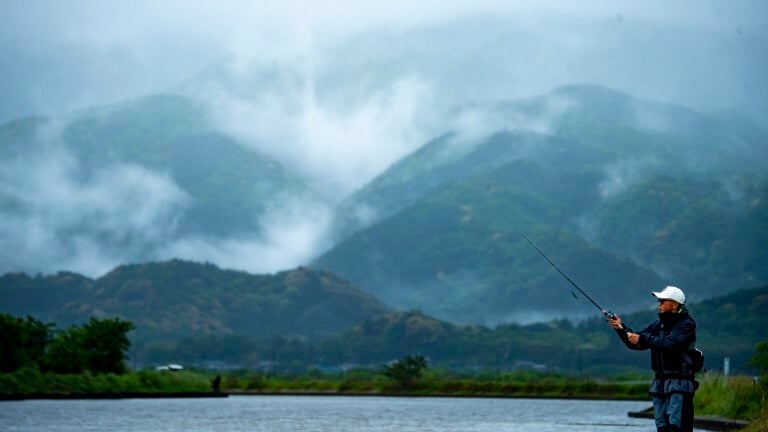
On Lake Biwa (Japan's largest lake, where the co-world-record largemouth was caught in 2009), one of the hottest techniques of recent years has been the weightless bottom jerk with the Deps Cover Scat. When we visited the lake, nearly every boat was clustered over the dredged holes offshore, and every angler was working their rod tip-down with total focus. The technique has since spread across Japan, and here the guide who started it, Takeru Tomimoto, shows how to fish it and why it works from the bank, too. Surprisingly, when we pitched him this story, he asked to do it from the bank.

Contents
Takeru Tomimoto, the guide who changed Lake Biwa bass fishing with the Cover Scat
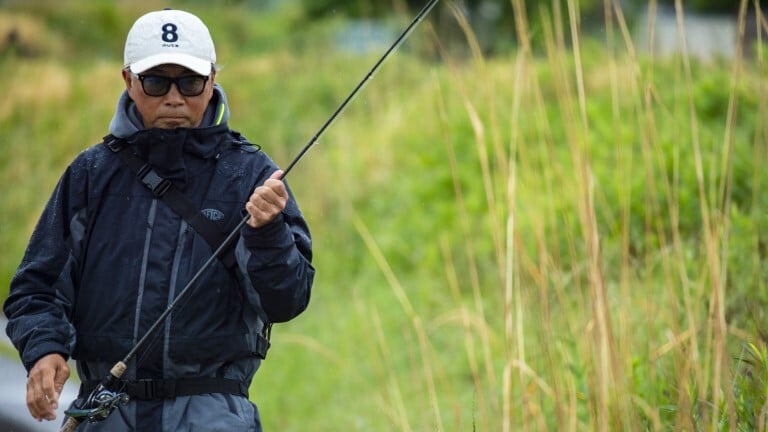
Takeru Tomimoto is now one of the most popular guides on Lake Biwa, but as a bass pro, he was a late bloomer. He gave up on a career as a pro Jet Ski racer and set out to become a Lake Biwa guide at around 30. For the first few years he fished the lake relentlessly, drilling the seasons and every kind of pattern into himself.
He opened his guide service in his mid-30s, but in April of his first year, only two parties booked him, and both were friends. Social media wasn't what it is now, so he scraped together clients through mixi (a Japanese social network popular at the time). For more than 10 years after that, filling half the month with bookings was the best he could do.
Tomimoto: "Kenta Kimura, who started guiding around the same time, and Masayuki Matsushita, a younger guy from my area, got popular in no time (laughs). I wanted to learn Lake Biwa, so I was out on the water even on days with no clients, and the gas money added up. Money was really tight."
Patient and steady, Tomimoto kept building his skills, and it finally paid off in 2016. At BAIT (now MBFT), a Lake Biwa tournament series, he won with a then-record 28,935 g (about 63.8 lb) for 10 fish over two days, fishing a long worm on a Punch Shot rig.
Tomimoto: "My name finally got out, and lots of clients started coming. I even made the cover of Basser (Japan's first bass fishing magazine, founded in 1986) (laughs)."
He was already 47. It would be nice to wrap it up there, the late bloomer who finally saw light at the end of the tunnel, but his real breakthrough came after that.
How the Cover Scat bottom jerk was born
Around 2018, Lake Biwa was going through a major shift: the grass had died off and the bluegill population had dropped sharply. Established patterns lost their punch across the board, and what took their place was weightless jerking the Sakamata Shad (Deps' soft jerkbait) near the surface. Tomimoto was quietly doing the same thing on the bottom. When he jerked the biggest 8-inch Sakamata along the deep bottom, monster-class fish ate it like crazy. The arrival of the Ultrex in 2017 (a trolling motor with built-in GPS that can hold the boat on any set of coordinates) also did a lot to make slow techniques more precise.
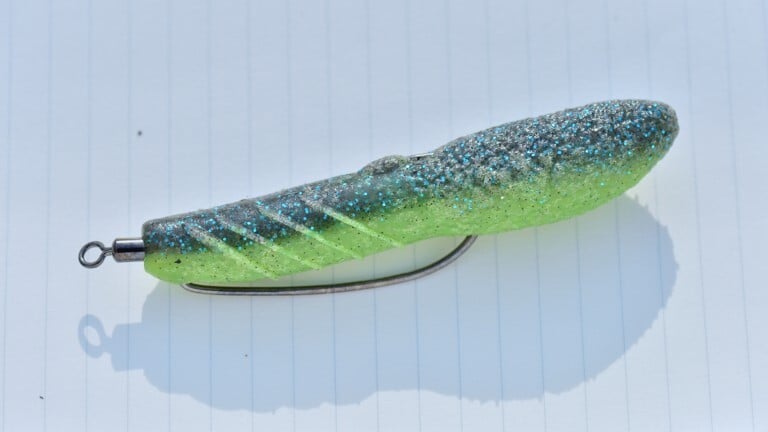
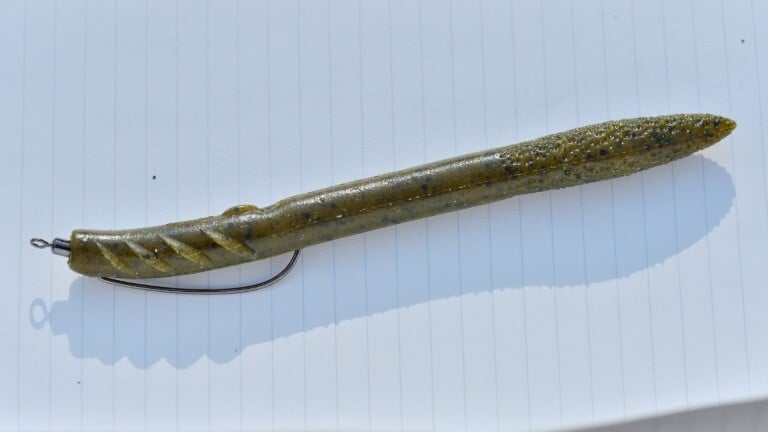
Tomimoto: "I think it was winter 2018. At one spot, the 8-inch Sakamata stopped getting bites, and while I was thinking about downsizing, I noticed an unopened pack of Cover Scats I'd never used since they came out. When I first saw it, between the looks and everything, I thought, 'Mr. Okumura (Kazumasa Okumura, who designed the bait) sure made a weird one,' and I didn't really feel like using it (laughs). It was originally designed for flipping and pitching cover, as the name says, but it looked pretty dense, so I figured I'd try it deep like the Sakamata. And I hammered them. From the spot where the Sakamata bites had dried up, I caught ten fish over 50 cm (about 20 in) in a row. Dragging a Senko-type bait or another dense weightless bait on the bottom, or deadsticking it, has been around forever. But I didn't come from that direction. I came at it as an offshoot of jerking the Sakamata. And I did it deep, where nobody else was fishing it or even wanted to, and I think that's what set me apart."
For a while after that, the Cover Scat kept getting bites no matter the conditions. It was deadly when bass were eating bottom forage like shrimp and gobies, and it caught fish even when they weren't. Tomimoto racked up stunning results in tournaments and in magazine head-to-head features, and he quickly became one of the leading figures on Lake Biwa.
Back to basics: how to work the Cover Scat bottom jerk
The Cover Scat bottom jerk spread from Lake Biwa across Japan. Many makers released their own versions, and in 2021, Haruki Takeda won the JB TOP50 (Japan's top pro tour) event on the Onga River with this method. In the uppermost section of the river, which the competitors had pounded relentlessly with their boats packed together, what beat that extreme pressure was a Cover Scat on 20 lb fluorocarbon. It came as a real shock.
So let's quickly review how to fish a weightless Cover Scat bottom jerk.
1. From a boat, basically make a full cast. Approach the target spot from as far away as you can. This is partly to deal with pressured bass, and partly to keep the line lying as flat as possible underwater.
Tomimoto: "Casting distance matters. Especially on Lake Biwa, bass have gotten really nervous about LiveScope beams and the boat itself. A lot of times, fish close to the boat won't eat a dice-type bait (a small, cube-shaped finesse bait), but they'll eat a Cover Scat cast in from beyond where the LiveScope beam reaches, roughly 30 m (about 100 ft) or more."
2. Let the bait free-fall until it hits bottom. It's hard to feel a weightless bait land, so count it down based on the Cover Scat's sink rate of 1 m (about 3.3 ft) every 3 seconds (with the 3.5-inch on 20 lb fluorocarbon), matched to the depth. That means 12 seconds for 4 m (about 13 ft), the typical depth in the South Basin (the shallower southern part of Lake Biwa), and 30 seconds for 10 m (about 33 ft) deep in the North Basin.
3. Once the bait is on the bottom, work it with a basic cadence of two jerks and a six-second pause. The first few cycles aren't so much about getting bites as about quickly straightening the line, which still arcs upward underwater before it fully sinks, and bringing it down to the bottom. In Tomimoto's experience, it takes five or six cycles in deep water before the line lies flat on the bottom, and nearly all the bites come after that. Getting the line to lie along the bottom is the single most important thing for getting natural bites.
Tomimoto: "As you get used to it, you'll be able to tell what the line is doing underwater by the resistance. When it's lying on the bottom, you should feel a little more weight when you jerk it than when it's floating loosely in the water. Also, when the line from the rod tip to the water points more straight down than at an angle, that's proof it has sunk properly."
Tips for the jerk-and-pause action
There's a reason the action is jerk-and-pause. It imitates the quick dart off the bottom and slow settle back down that gobies make when they feed, which makes bass more likely to strike.
Also, with a retrieve that keeps the line tight for long stretches, like dragging, the line you worked so hard to lay along the bottom gets lifted and comes into the bass's view. In other words, it spooks them. With a jerk that lasts only an instant, the line doesn't lift.
Make the jerks short and crisp, more like twitches, and gentle enough that the worm walks the dog in place: tap, tap. While you work it, keep the rod tip pointed at the water (shortening the line between the rod tip and the surface), so wind has less effect and the line is less likely to lift.
Tomimoto: "The six-second pause is partly to let the line sink, and I also think it's the perfect gap to hold a bass's interest without letting it get bored. A bass comes up to the bait and studies it closely, and just before it figures the bait out, the bait darts away, and that flips the switch. It's like playing Red Light, Green Light with the bass." Done right, it takes about 10 minutes to work a full cast all the way back. That's how it should be.
Where to use the Cover Scat bottom jerk
Tomimoto: "I think the Cover Scat bottom jerk is the ultimate finesse presentation: it hides the line and entices fish with a weightless bait. But if you can only make six casts an hour, it's also a pretty risky way to fish. Use it on spots where you're sure fish should be, or where you can expect bass to move through."
The Cover Scat bottom jerk works from the bank, too
In 2025, now in his eighth season since he first figured out this method, how has Tomimoto refined it?
Tomimoto: "I'm not using it any differently than before, but more and more, they won't eat unless you do everything right. At first they'd bite even if you were a little rough, but on Lake Biwa especially, everyone has done it so much that the fish have finally wised up. Sink the line more thoroughly, make shorter, crisper darts that don't lift the bait too much, give the line more slack while you wait for a bite... and do all of it more slowly and carefully. It's tedious, but it's the fastest way to results."
It might sound like a mentally exhausting way to fish. But there's a magic bullet that lets anyone sharpen all of this dramatically, and easily.
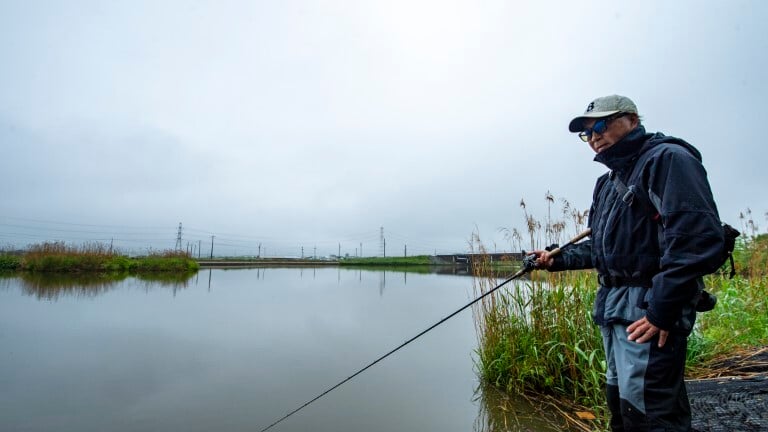
Fishing from the bank.
Why it works from the bank
To begin with, this technique is hard to pull off without stable footing. On a boat bobbing on rough water, it's hard to keep ideal line tension, and getting blown off the spot is a nonstarter. On a reservoir sheltered from the wind it's one thing, but on Lake Biwa this technique assumes you're using an Ultrex. Just by fishing from the bank, you clear that hurdle.
Getting the line to sink properly is also easy from the bank. It depends on the water, but in most cases it's shallower, and you're working the bait uphill from deeper water toward the shore, so the line lies along the bottom much faster than when you fish deep from a boat.
The last factor is pressure. From the bank, access is limited and other anglers are often already on the spots you want, so it usually comes down to squeezing bites out of whatever spot you can get.
As you may have noticed, the Cover Scat bottom jerk fits that perfectly. In fact, plenty of anglers have probably already figured out how well it suits bank fishing and are getting results.
Putting it to the test on one of Japan's most crowded bank-fishing rivers
Tomimoto: "When I got the offer for this story, I thought, 'Bank fishing, that could work.' I've always ground out Cover Scat fishing patiently from a boat, but it's true it'd be a lot easier from the bank, and I've heard plenty of people are doing it and catching fish. I also wanted to see how well it works on bass outside Lake Biwa."
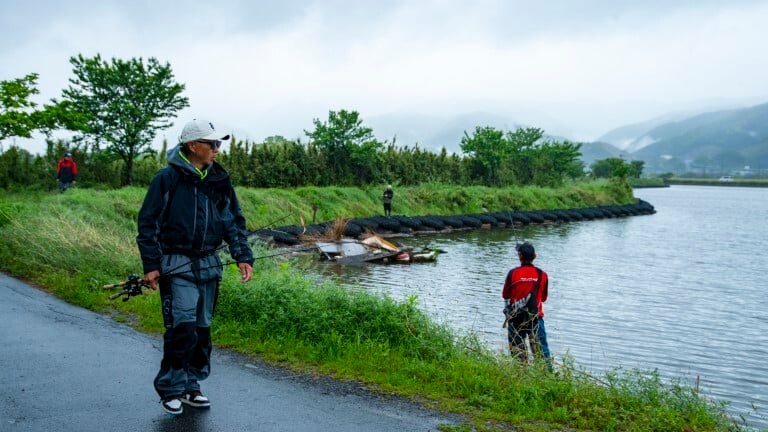
On a Saturday in May, Tomimoto headed to the Gosan River in Gifu Prefecture. With the Kasumigaura system (the lake system near Tokyo that long held that title) slumping in recent years, it has taken over as arguably the most heavily fished bank-fishing water in Japan. In fact, in the pool area upstream, 12 bank anglers were packed in within sight.
Tomimoto: "When I came to scout it during Golden Week (a run of national holidays from late April to early May), it was even crazier (laughs). There was nowhere to get in at all."
Along the concrete bank upstream, Tomimoto made a short pitch with the Cover Scat and, instead of bottom-jerking it, just dragged it. He got bit right away.
Tomimoto: "They'll eat it on a drag? These fish aren't picky! There are tons of people here, but the water's got some color, so they eat it without getting suspicious."
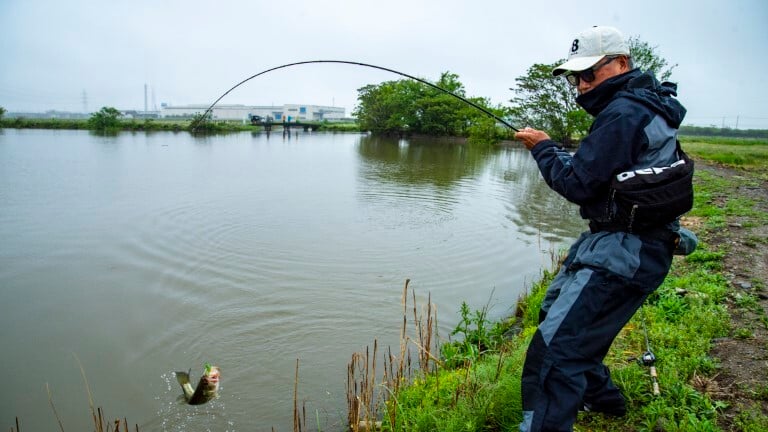
This writer also got to fish a 3-inch. The Gosan River offers stable footing and is no more than 1.5 m (about 5 ft) deep even out in the middle, so with the dense Cover Scat I had no trouble at all finding bottom, and I could work it while clearly feeling it touch bottom. What Tomimoto usually does, fishing deep from a boat, must take far more patience and be far harder (which is exactly why it sets him apart).
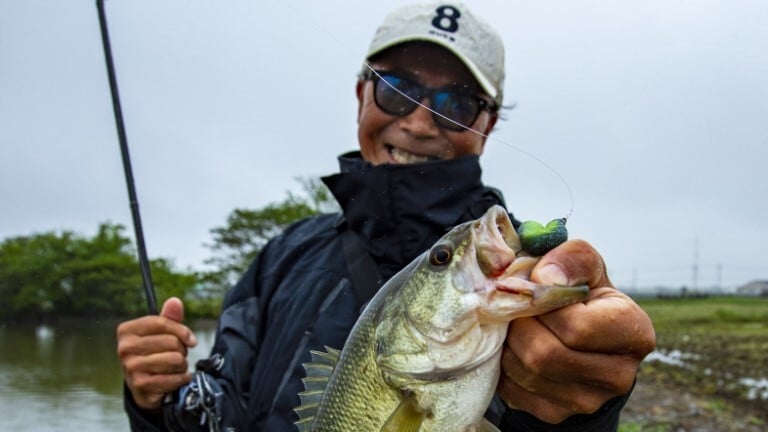
Tomimoto: "Oh, right, there is one thing that's clearly changed: the standard Cover Scat size. On Lake Biwa the 3.5-inch was the main size, but downsizing has been producing better results, so these days I usually start with the 3-inch. I also helped develop a dedicated hook with a built-in swivel that resists line twist, and a rod built for this technique, so the right tackle balance and bait setup are a must, too."
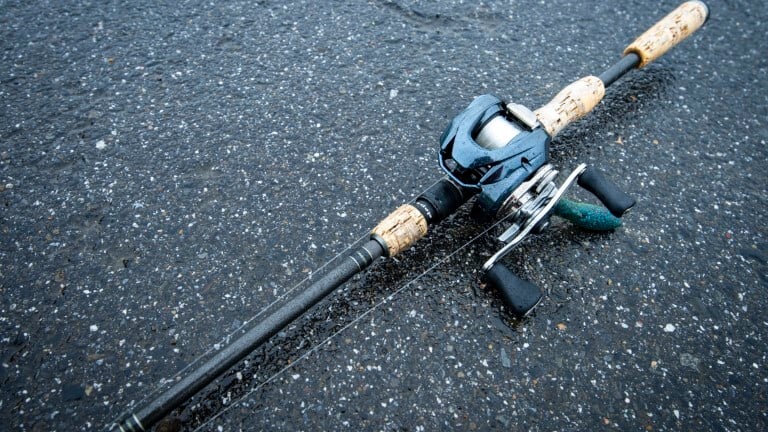
[For the 2.5- to 3-inch Cover Scat]
Rod: Gain Element Lightjerking Element (Deps; a prototype at the time, since released as the GE-67M+R, a 6'7" medium-plus casting rod)
Reel: Aldebaran DC XG (Shimano)
Line: Shooter Overtex 14 lb fluorocarbon (Sunline)
The rod is a prototype in development for weightless jerking small soft plastics: 6'7", M+ power. The line, specified as 20 lb for the 3.5-inch, drops to 14 lb to match the smaller bait and keep it easy to work. Because you detect bites with slack in the line, a stiff fluorocarbon with some body, like Overtex, is recommended.
*This page was adapted from the July 2025 issue of Basser.