


On Lake Biwa, on small lakes, in tournaments, and in the United States... Mid-strolling the Sakamata Shad has been fooling big bass around the world. We asked four anglers, starting with its designer Kazumasa Okumura, how the bait was born and how they fish it on a mid-strolling jig head.

Contents
Designer Kazumasa Okumura: A 4- to 8-inch bait born for weightless jerking
Interview 1: Designer
Kazumasa Okumura
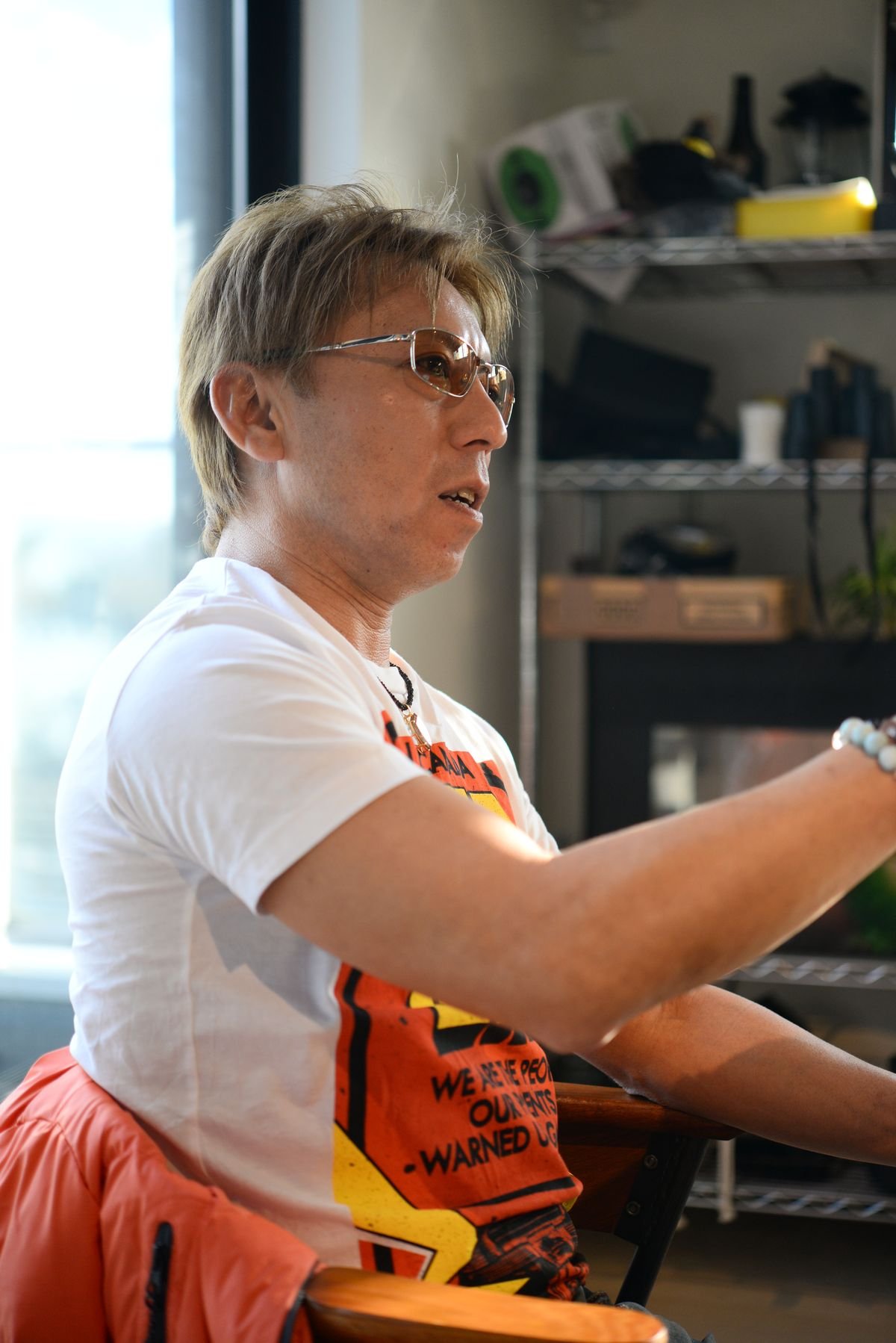
It started as a worm for the "shachihoko rig"
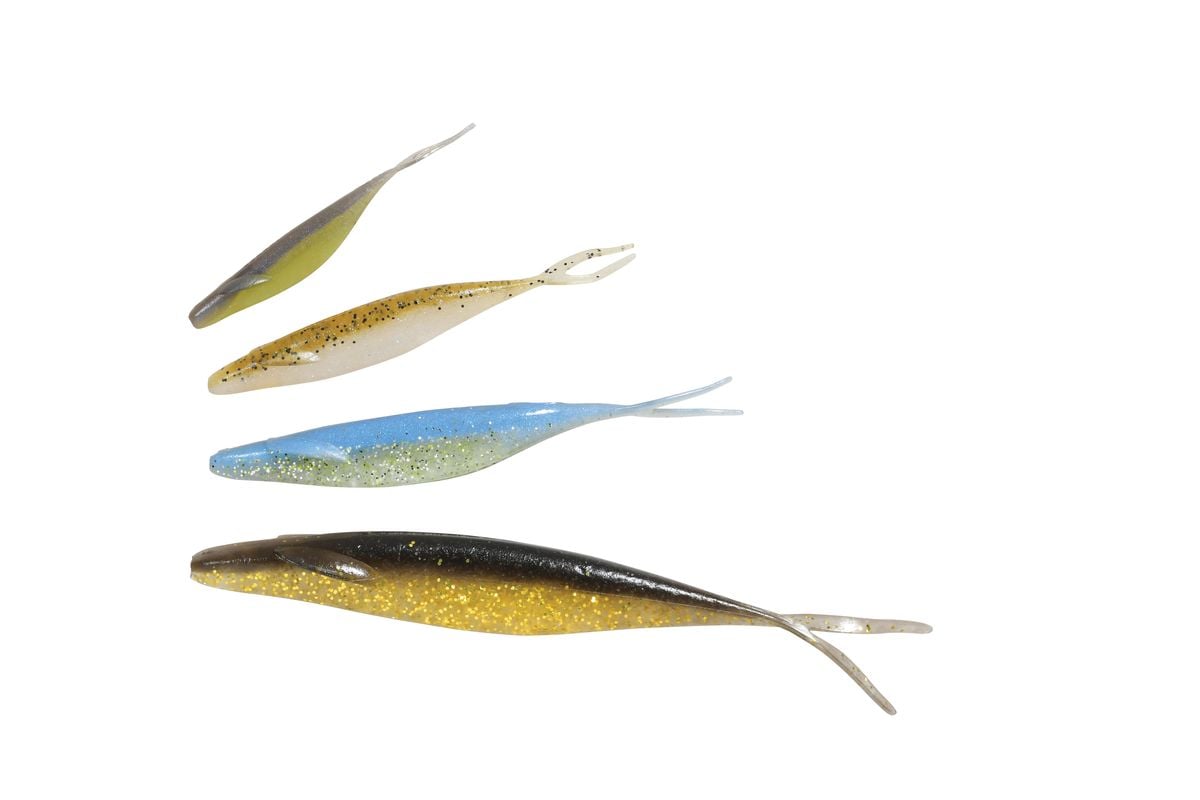
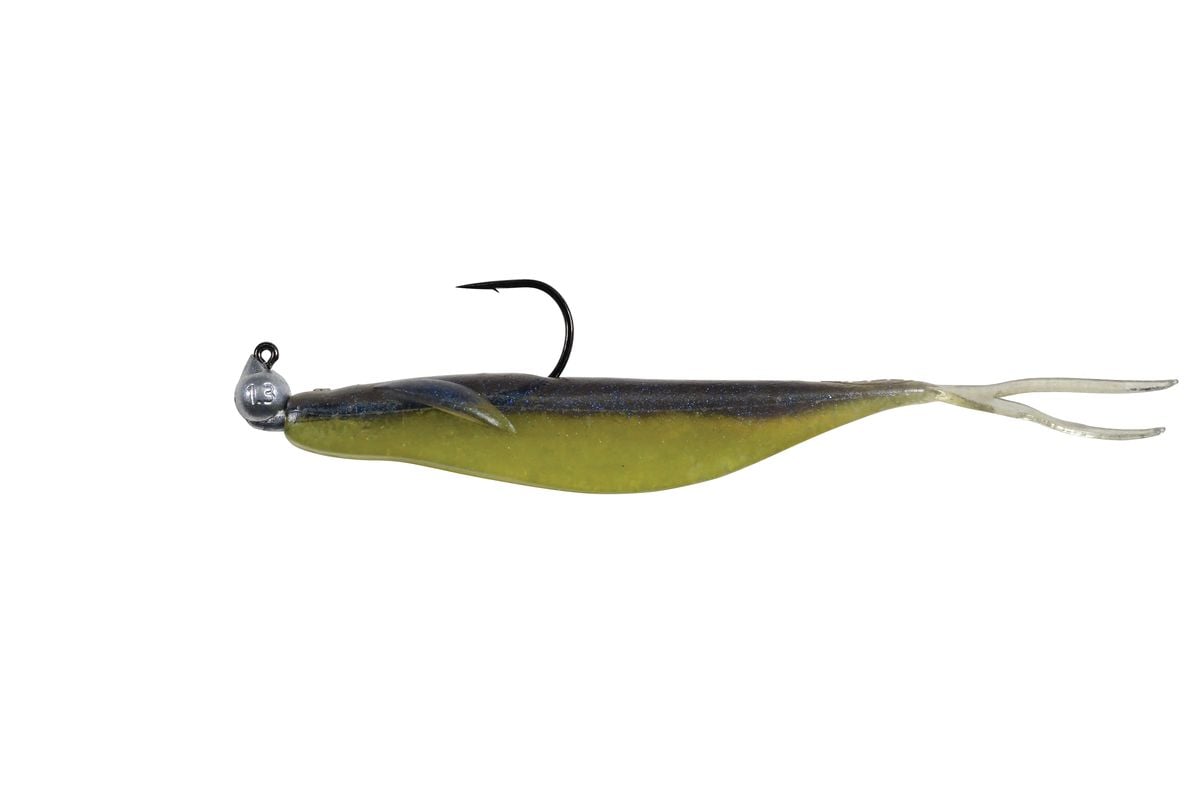
The Sakamata came out around 2015, I think. Back then, we weren't developing it so much for mid-strolling on a jig head as for the shachihoko rig and weightless jerking. The shachihoko rig is a heavy Carolina rig with the worm hooked so it arches back like a shachihoko (a mythical Japanese creature with a tiger's head and a fish's body, always shown with its body arched back and tail raised). When you work the rod, the worm darts upward and triggers a reaction strike. It caught a lot of fish, but getting the hook placement just right was hard. So I wondered if I could make a soft stickbait that kicks upward even when it's rigged straight, and that's how the Sakamata Shad, with its ear-like fins, was born.
Fellow pros Masayuki Matsushita and Kenta Kimura asked me, "Do you really need these ear things?" I completely ignored them (laughs). Those ears are the whole point. What are they even talking about?
Personally, I've caught the most fish on the Sakamata with a weightless jerk. I think the way it tries to leap toward the surface triggers a bass's instinct to pin baitfish against the surface.
In terms of material, it's also unusually soft for a soft jerkbait, and that's another reason it catches fish. Harder baits like the Fluke or the Slug-Go actually give you a crisper action on the jerk, but the soft Sakamata slides with a tight, full-body shudder the instant you jerk it. That "shiver jerk," combining speed and softness, is what works.
Braided line, trolling motors and LiveScope are why it took off as a mid-strolling bait
So... mid-strolling (laughs). Honestly, I never expected it to break out this big as a mid-strolling worm. It catches fish weightless on its own, so I knew it would catch fish on any rig, but I don't think anyone was seriously exploring the Sakamata as a mid-strolling bait.
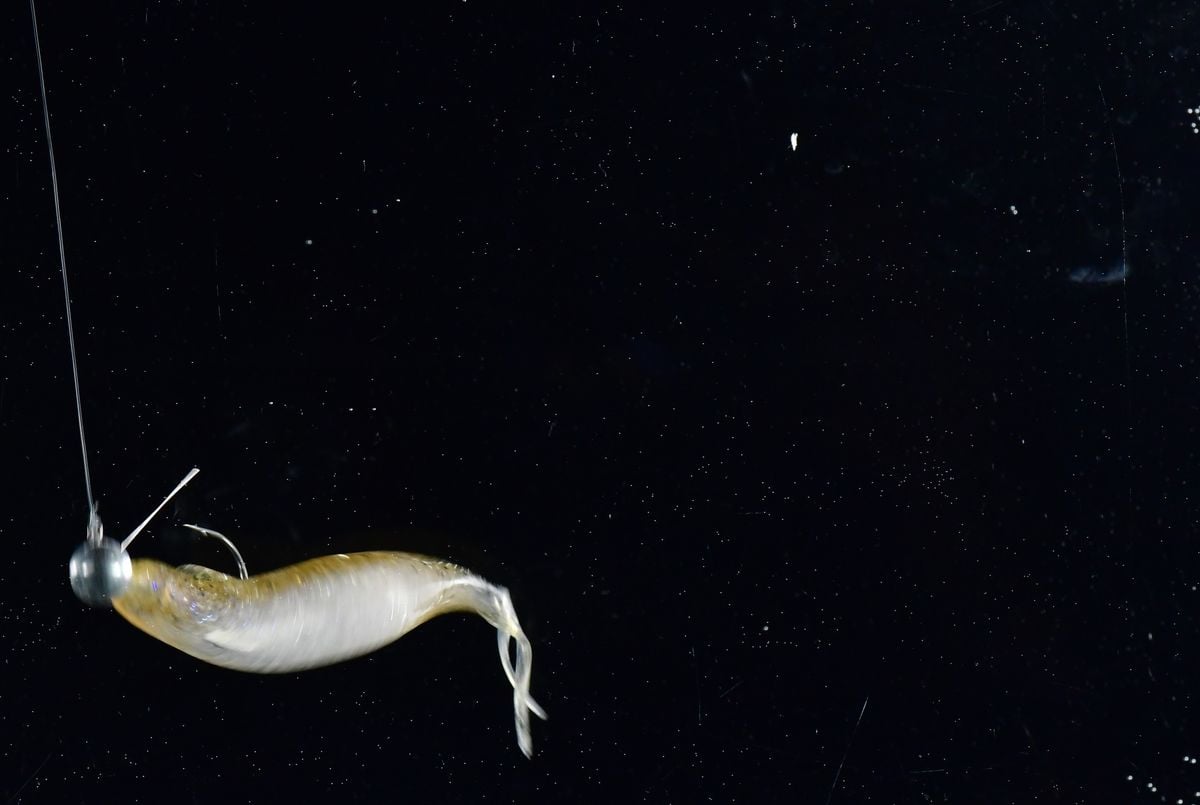
There's no doubt that the evolution of gear is why people realized mid-strolling the Sakamata works. First, braided line. It made it possible to mid-stroll down to 10 m (about 33 ft), a depth you could never reach with fluorocarbon.
Then there are trolling motors like the Ultrex, whose Spot-Lock can hold the boat completely still. Running the bait precisely past a spot such as a man-made fish attractor became far easier. And the clincher was LiveScope (forward-facing sonar). Are fish there or not, will they chase or not, is my lure staying in the zone... With this fish finder, the two biggest challenges of mid-strolling, efficiency and depth control, are solved at once.
It's a given that mid-strolling the Sakamata catches fish. More than anything, the gear that lets it reach its full potential is now in place.
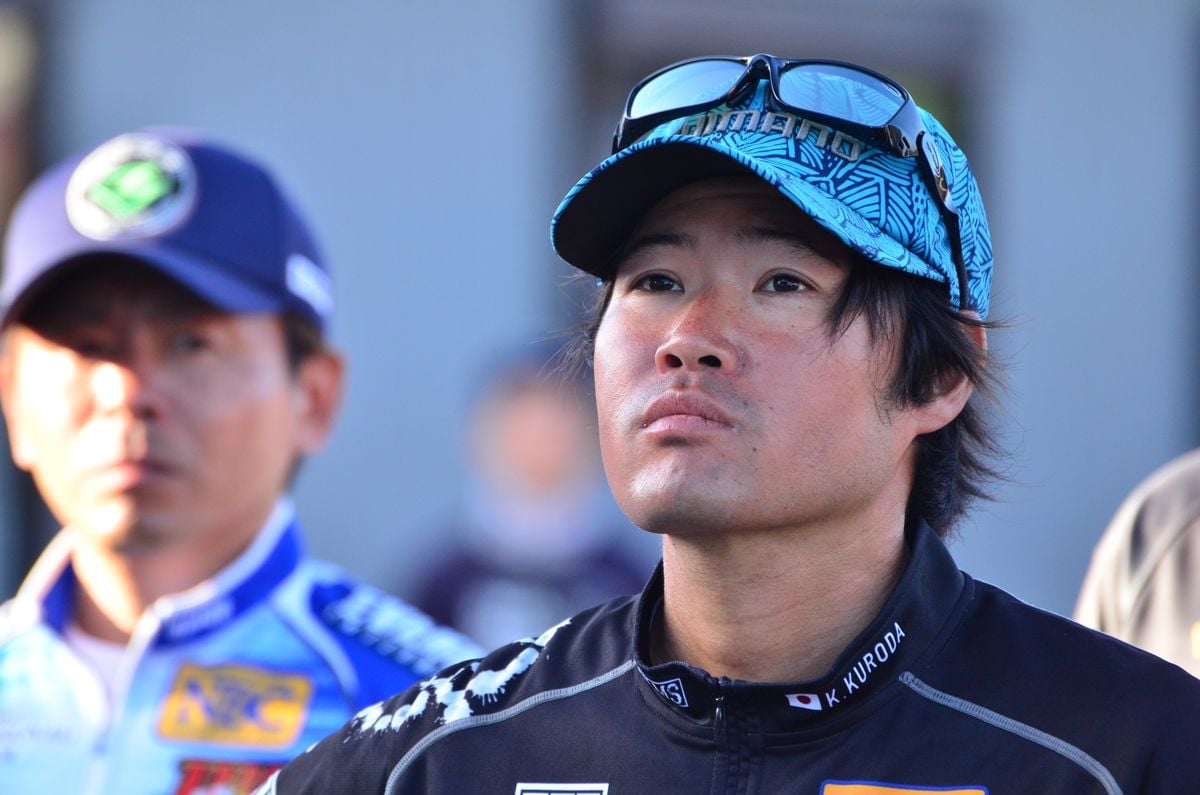
Kenshi Kuroda: The higher the pressure, the more he mid-strolls a 5-inch on a 3.5 g (1/8 oz) head
Interview 2: Tournament angler (JB TOP50 pro; Japan's top pro tour)
Kenshi Kuroda
Not a magic bait, but No. 1 in its class for all-around strength
To be honest, for me the Sakamata Shad isn't the kind of lure that nothing else can replace. Of course it catches a lot of fish, but if I'm mid-strolling, I think a Fluke would catch fish too.
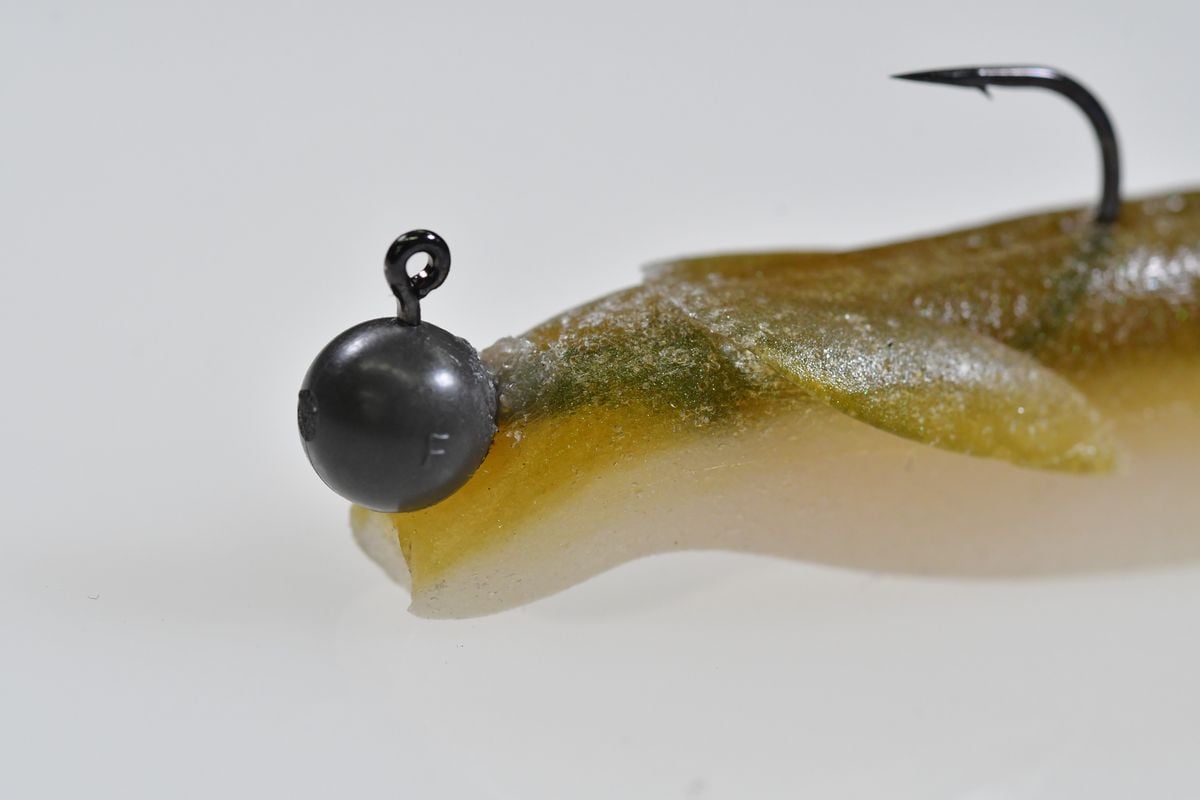
But the Sakamata comes in colors you can't get in a Fluke. Baitfish colors like ayu (sweetfish) and wakasagi (Japanese smelt) are especially important. On top of that, it comes in lots of sizes, and even a different-density model like the Heavy Weight. There are no gaps, and that's impressive. Plus it's Feco-certified (an eco-certification required for baits in JB tournaments), so you can use it in tournaments (laughs). For those reasons I always end up thinking, "Yeah, it's got to be the Sakamata."
The Sakamata I use for mid-strolling is mainly the 5-inch. That's on the big side for mid-strolling, where worms around 3 inches are the norm.
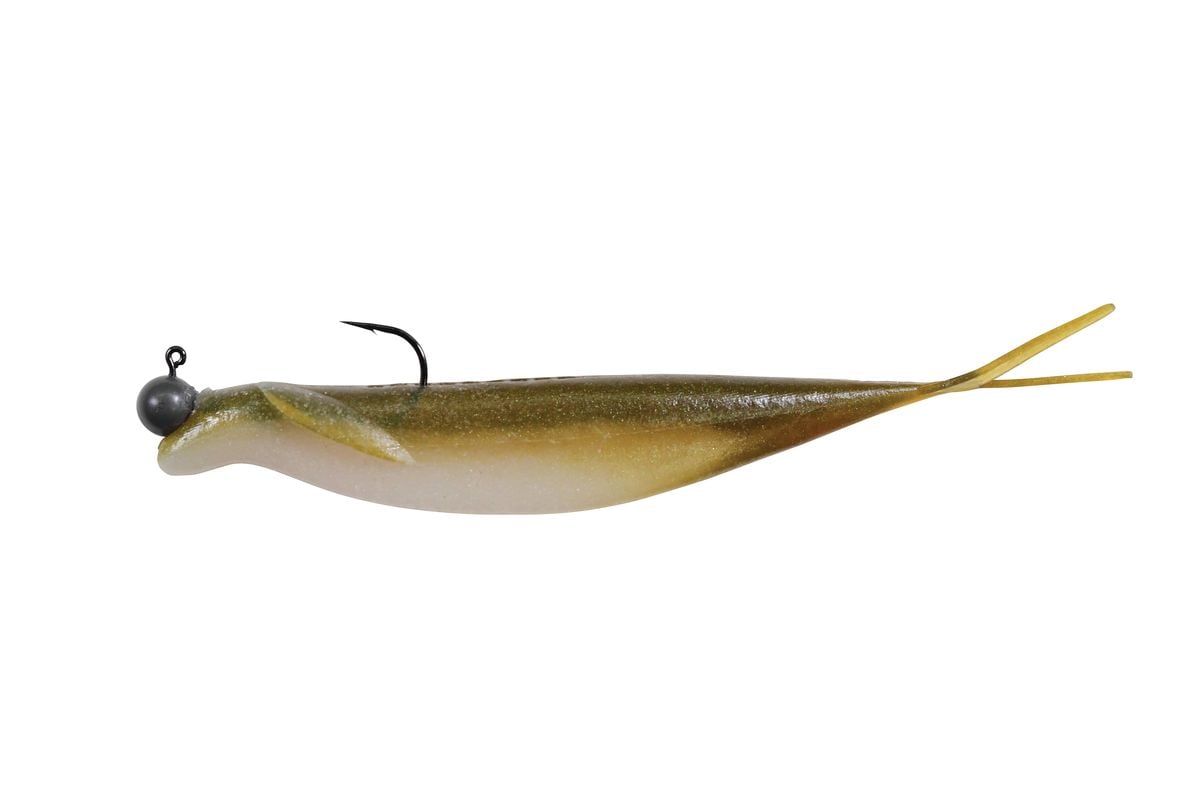
[Recommended tackle]
Rod: Expride 2610ML (Shimano; 6'10" medium-light spinning)
Reel: Stella C2500S (Shimano)
Line: Pitbull G5 braid (Shimano), PE #0.8 (13.7 lb)
Leader: fluorocarbon 8-12 lb
Past a certain level of pressure, bites concentrate on bigger baits
When a lake gets pressured, like in a tournament, everyone inevitably downsizes. But once the pressure crosses a certain line while everyone else is throwing small worms, the bites can actually concentrate on bigger baits. This happens not only in tournaments but also on popular lakes on weekends.
A good example was the 2021 JB TOP50 final on Lake Yasaka. It's a small, electric-motor-only lake, and more than 50 top pros pounded the entire lake for days. In that situation, I finished third by mid-strolling a 5-inch Sakamata. The winner, Yui Aoki, was throwing a big bait too: a 168 mm (about 6.6 in) Last Ace.
That said, when you upsize, it's better not to stray far from the size of the baitfish in that lake. On the other hand, on a lake where bass usually eat bigger baitfish, I think you can upsize without hesitation no matter how much pressure there is. The angler who's overwhelmingly good at drawing that line, "how far small baits keep working, and how much pressure it takes before big baits start to work," is Kazufumi Yamaoka. In 2021, at the JB event on Lake Tsuburo, while the anglers around him were mid-strolling baits matched to 5 cm (2-inch) wakasagi, he alone was hammering them on a 5-inch Sakamata (laughs).
And with a bait as big as the Sakamata that moves that much water, you can use it as a search bait even without LiveScope. LiveScope definitely makes you more efficient, but at this size the bait will pull fish in even if you're a little off the depth.
Masayuki Matsushita: 5 or 6 inches to match the forage in the U.S., bottom-strolling on Lake Biwa
Interview 3: Tournament angler (Bassmaster Elite Series pro)
Lake Biwa pro guide
Masayuki Matsushita
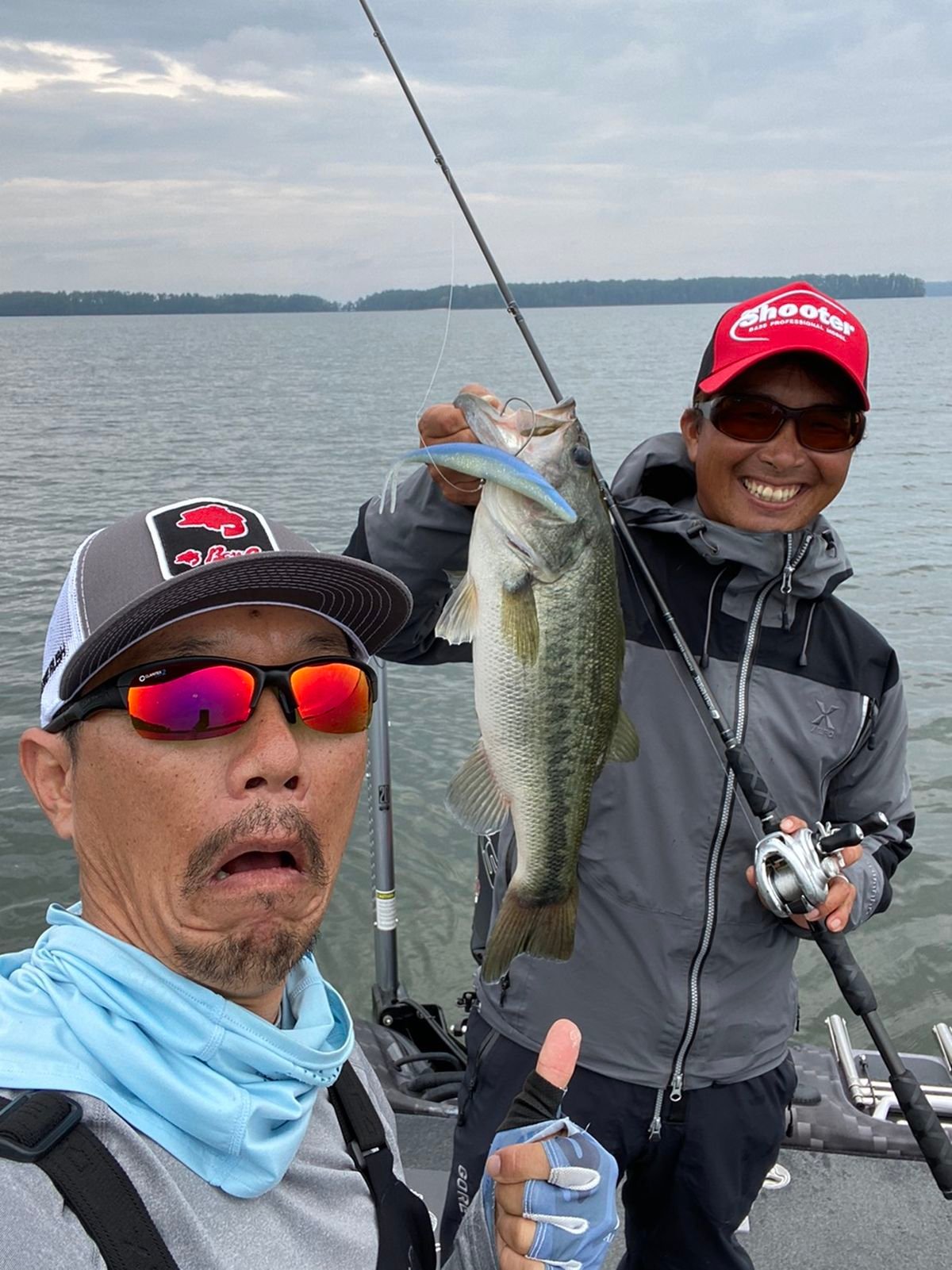
In the U.S., it's mostly short-range target fishing
Whether in the U.S. or in Japan, I don't use a Sakamata mid-stroll to search wide areas. It is a horizontal presentation, but basically I run it past a key spot and get them to eat.
In the U.S., I target vertical cover like boat docks, standing timber and brush piles at short range. Rather than keeping it at a set depth, I picture it swinging past on a tight-line fall. I keep working the rod, of course, so the bait rolls the whole time. I think of it as a super-finesse moving bait.
Most American anglers fish these spots with bladed jigs, swim jigs or spinnerbaits. With the Sakamata, you check each spot more slowly, but in exchange you'll outfish them almost every time. You can still catch fish behind other anglers, so I don't worry much about someone fishing ahead of me.
I match the size to the forage: the 5-inch when the main forage is threadfin shad, the 6-inch for gizzard shad.
The great thing about the Sakamata is how soft the material is. Not only is the action better, but compared with a stiffer bait like the Fluke, it folds on the bite, so it gets into the bass's mouth easily and hooks up well. The bigger the size, like the 6-inch, the clearer the difference.
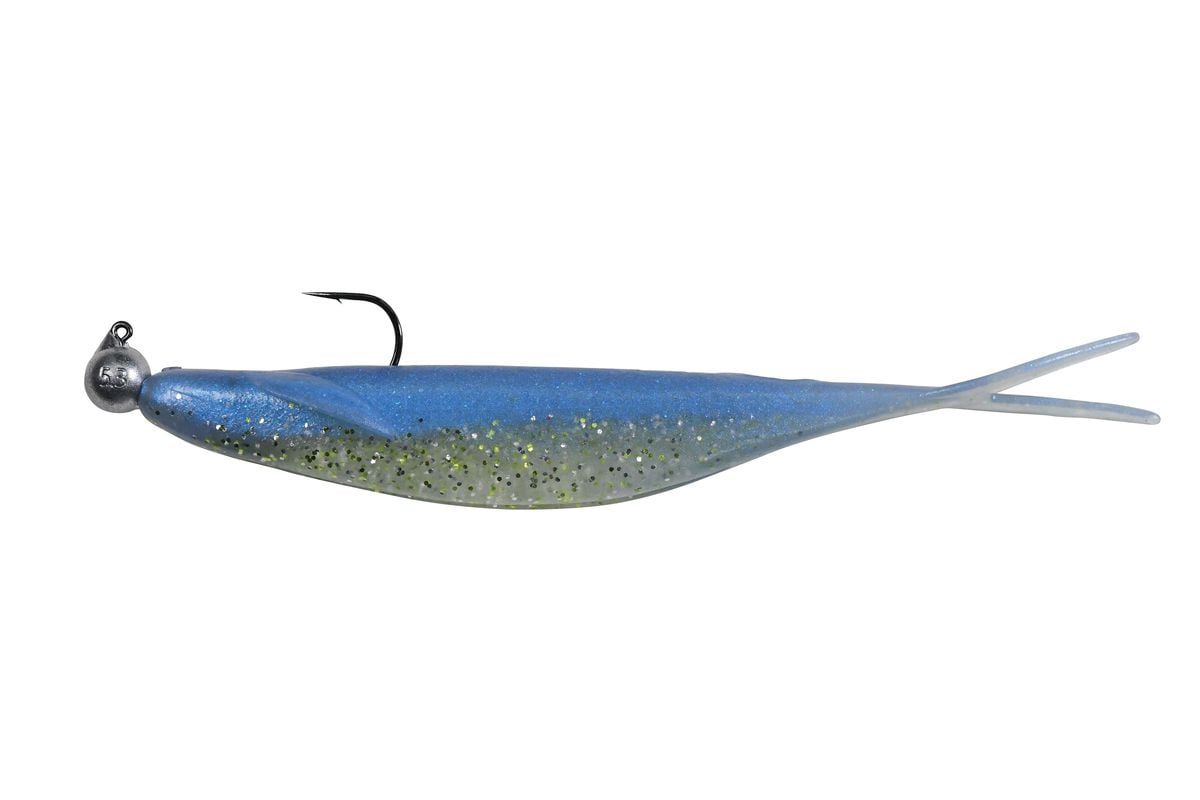
Matsushita's favorite colors include Reservoir Shad, Golden Shiner and Silver Shad. All are two-tone colors that flash as the bait rolls. The Range Roller is a roll-enhancing jig head with the head offset high. Because its center of gravity is already high, you don't need the usual mid-strolling trick of threading the hook shallowly through the back (it would actually raise the balance point too far). The wide roll keeps the bait from coming toward you too quickly, for a slow, lingering mid-stroll.
[Recommended tackle]
Rods: GES-66MLS Shaking Element (Gain Element; 6'6" medium-light spinning, for long range or the 6-inch), Light Shaking Element (Gain Element, prototype; for short range or the 5-inch)
Reel: Stella C2500XG (Shimano)
Line: D-Braid 13 lb (Sunline)
Leader: Shooter fluorocarbon 10-12 lb (Sunline)
On Lake Biwa, where you fish at long range, bottom-strolling is easier
The basic Sakamata mid-stroll on Lake Biwa is fishing deep with a jig head of around 5 g (about 3/16 oz). But Lake Biwa is deep and you cast long distances, so keeping the bait in the zone is hard without serious skill or gear like LiveScope. That's why I recommend bottom-strolling to my guide clients.
After the cast, let it hit bottom once, then work the rod just like mid-strolling as you bring it back. Ideally it touches bottom two or three times per cast. Even while it's touching bottom, it still rolls surprisingly well.
If you're fishing a visible target like a water intake tower, that's one thing, but this is basically offshore fishing, so you'll want a fish finder. You don't need LiveScope, but a fish finder with GPS mapping, so you at least know where you are relative to the submerged cover and how far away it is, gives you all the precision you need.
Taiki Hasegawa: A 4-inch on a 2.7 g (3/32 oz) head at 10 m (33 ft) on Lake Nojiri
Interview 4: Lake Nojiri pro guide
Taiki Hasegawa
A band of murky water around 10 m deep is your chance
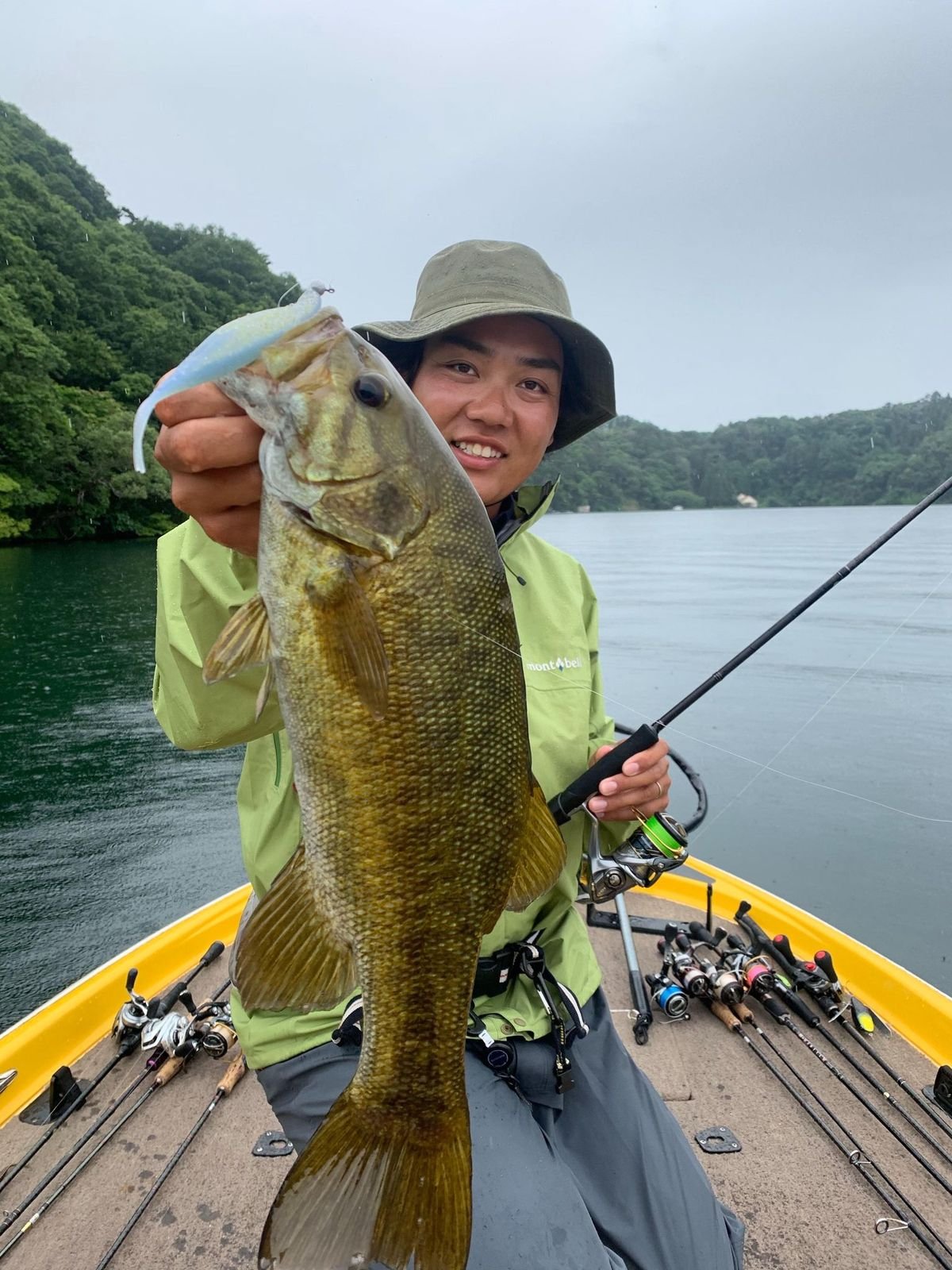
On Lake Nojiri (a smallmouth lake in Nagano, Japan), from late summer into fall a band of murky water sometimes forms over the deep flats around 10 m (33 ft), and you can see it even on an ordinary 2D fish finder. Schools of small kokanee suspend above that band, the bass feed on them, and a pattern sets up. That's when I mid-stroll a 4-inch Sakamata Shad.
Maybe it's the ears, but the Sakamata feels like it really grabs the water, so even mid-strolling deep with a light head, you can feel it working and stay focused.
On Lake Nojiri, about 70 percent of the smallmouth chase wakasagi year-round. Following the wakasagi eaters is consistent, but it's hard to catch good-size fish that way. The other 30 percent that aren't on wakasagi are fewer but more likely to be big, and besides kokanee they eat all kinds of things, like cicadas and shrimp. They're hard to pattern, but personally I love chasing that minority of fish that could give you a jaw-dropping catch.
As for the retrieve, after a long cast, first let it hit bottom, then start mid-strolling as if lifting it off the bottom. To keep it hovering as much as possible, I use a light 2.7 g (about 3/32 oz) head even at 10 m, so the rig inevitably rises. So about twice per cast, I stop reeling and let it settle back to the bottom.
[Recommended tackle]
Rod: Super Trickster STS-69ML (Jackson; 6'9" medium-light spinning)
Reel: Vanquish 2500 (Shimano)
Line: braid, #0.4 in Japanese PE sizing
Leader: fluorocarbon 6 lb
*This article was originally published in the April 2022 issue of Basser and has been updated and re-edited.
*Anglers' titles are as of the time of the interview.